

Following my previous article I noticed that many Singaporeans seem to misunderstand the purpose of naturalisation of about 25,000 residents of the island each year.
Please note the word: residents.
Issuing new citizenships (or even PR, for that matter) does not increase the population of the island, because it is a privilege granted only to current residents, who have already proved themselves and their suitability as future citizens.
In other words: they're already here and have been for a long time.
We're talking about workers with years of experience, foreign entrepreneurs and investors, or spouses of Singaporeans.
The same is true for Permanent Residence, which is issued to people who have already worked on a local EP or S-Pass, and fulfil other criteria to qualify (income, education, origin, family etc.).
The only path for foreigners to instantly become PRs is through the Global Investor Programme, which has obscenely high requirements (major stake in a very large business and investment commitment in Singapore into tens of millions of dollars).
This is why, when the government in Singapore issues Permanent Residence or grants citizenships, it is operating within a group of hundreds of thousands of people who are already in the country.
They do not steal your jobs or homes, because they already have each of them. They may now qualify for a few additional benefits, but that doesn't fundamentally change the situation of everybody else.
Why does Singapore need them as citizens?
The fundamental bet appears to be that a citizen is more loyal to the country than any expatriate can be. Especially as Singapore forbids dual citizenships.
What's more, while Singaporean passport provides many benefits, it also imposes obligations in regard to National Service of future children of those new citizens.
Conscription remains the backbone of Singapore's defence and, as the society not only shrinks in numbers but gets older, there are fewer and fewer young men who can serve in the military.
The city-state has always been small, relative to its neighbours, but right now it is facing a numerical decline while both Malaysia and Indonesia keep growing, making the gap even larger.
Even in the age of AI and robotics, a country still needs men able to defend it.
And because Singapore was built by immigrants and has virtually no truly indigenous population, there's no reason to think that suitable newcomers will be less worthy citizens than the current ones.
This approach has worked for 200 years, after all.
Unlike in the past, though, the modern government has put specific numbers on the most desirable outcomes.
After all, Singapore's authorities are known for their methodical approach to governance, so it's hardly a surprise to learn that every policy has a quantifiable reason – including this one. The main, as we all know by now, is the fact that Singapore is ageing rapidly.
The local population is about to start dying out (Chinese Singaporeans already are, in fact). And given how low the local fertility rates are (which is a global crisis pf the developed world) the only way to fill the gaps is through naturalisation of foreigners.
Back in 2012, the government published population projections under the following scenarios, with and without new citizenships and the Total Fertility Rate of 1.2 (which already looked bleak then, but has since dropped to 0.87).
It also added a "no immigration & TFR of 2.1 (which guarantees basic population replacement)" for reference.
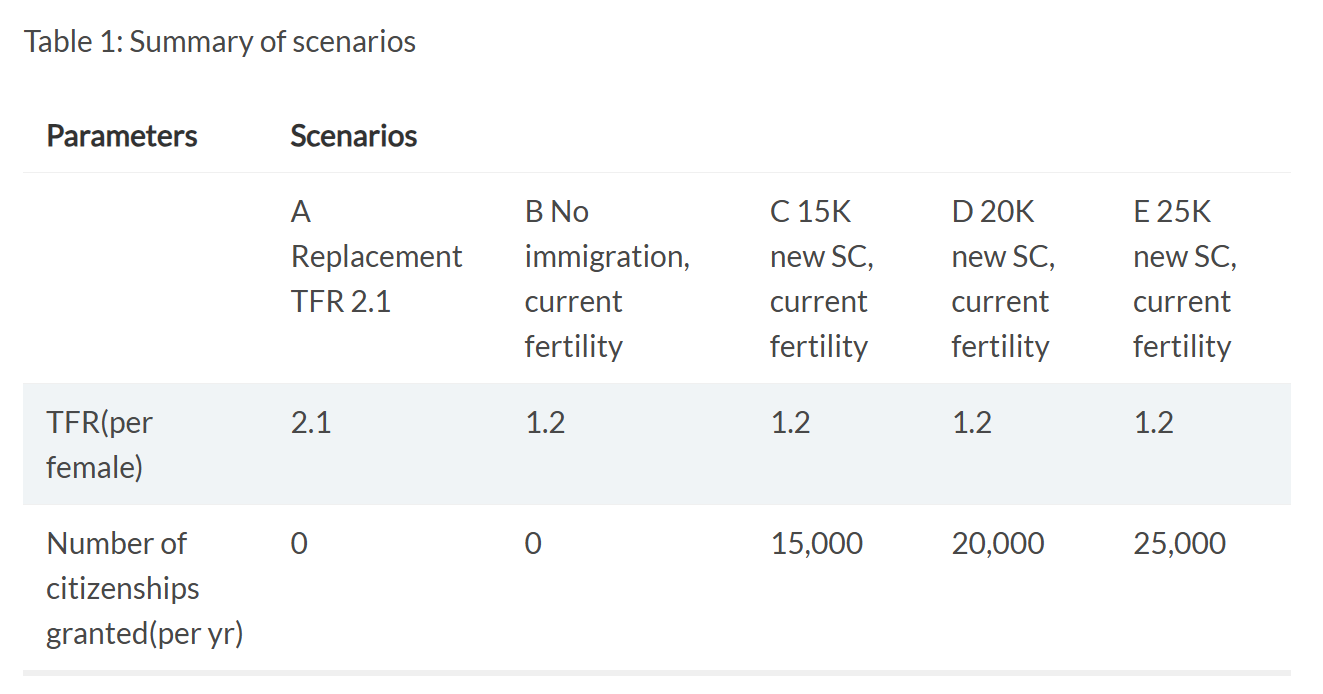
Here are the results it produced:
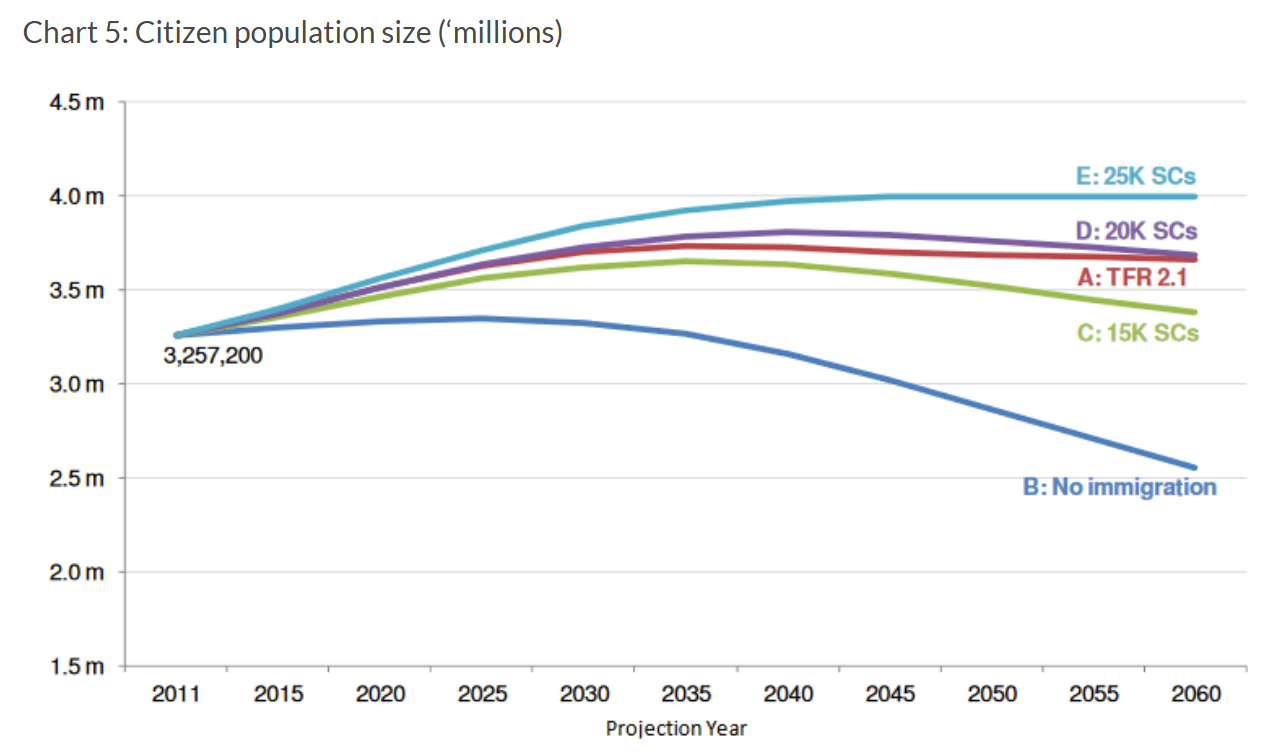
As you can see, there are only two options which guarantee long-term populational stability of Singapore citizens. Either Singaporeans begin having almost three times as many babies (red line) or the country grants at least 25,000 new citizenships every year (light blue).
I don't think it's a coincidence that this study came out within a year of the 2011 electoral scare, when the Workers' Party won its first GRC, in an upset for the PAP that many attributed to several years of open borders, which had reportedly made many Singaporeans feel foreign in their own country.
The government may have felt the need to better explain why it did what it did, ever after the milk had been spilt already.
It did reduce admissions of non-residents in subsequent years, but has continued to issue around 20,000 to 22,000 new citizenships annually, with the target recently raised to 30,000 over the next five years, since the TFR fell from 1.2, used for earlier forecasts, to just 0.87 in 2025.
Another measurable metric that the government follows, is the one I touched on in the previous article: the Chinese/Malay/Indian ethnic proportions.
Since the Chinese population has already started shrinking, while Malay and Indian numbers are still growing, the rough ratios of 75% / 15% / 7.5% are at risk of changing in the future.
As a matter of policy, Singapore decided a long time ago to keep these roughly at the same level, to avoid stoking racial tensions which could come from the accelerated growth or decline of one group over the other.
And, as I explained, given that the number of Chinese Singaporeans dropped by 3,000 last year, the proportional need for new citizens of Chinese descent has jumped to 18,000 annually (plus a few hundred Indians), just to keep the CMI proportions intact.
This fits within the 25,000+ range determined for other reasons.
Besides ensuring stability of local citizen numbers and ethnic balance between them, Singapore also needs to put a lid on the average age of its people and ensure there's a sufficient number of young men it can conscript into National Service each year.
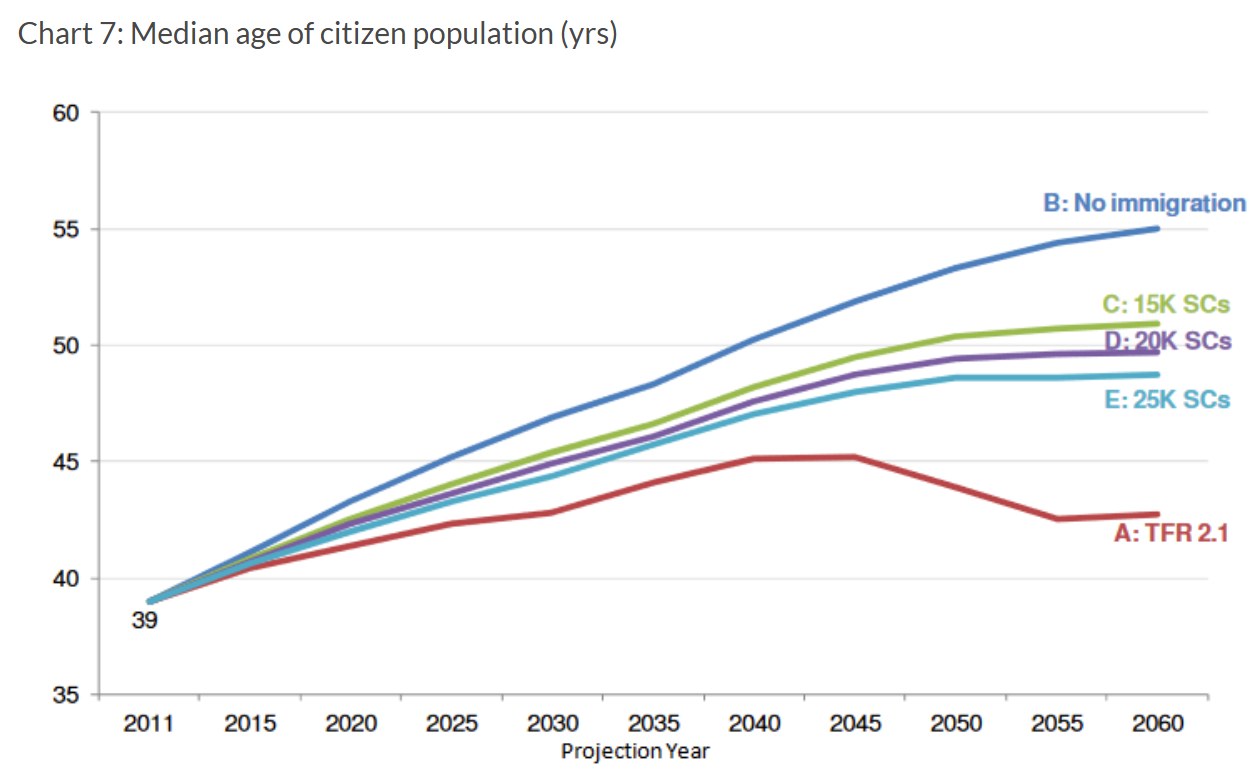
This is because the general population figures do not reveal anything about the underlying structure. A country with a large share of pensioners will be less economically active than one where they make up just a few percent.
That too was modelled in 2012:
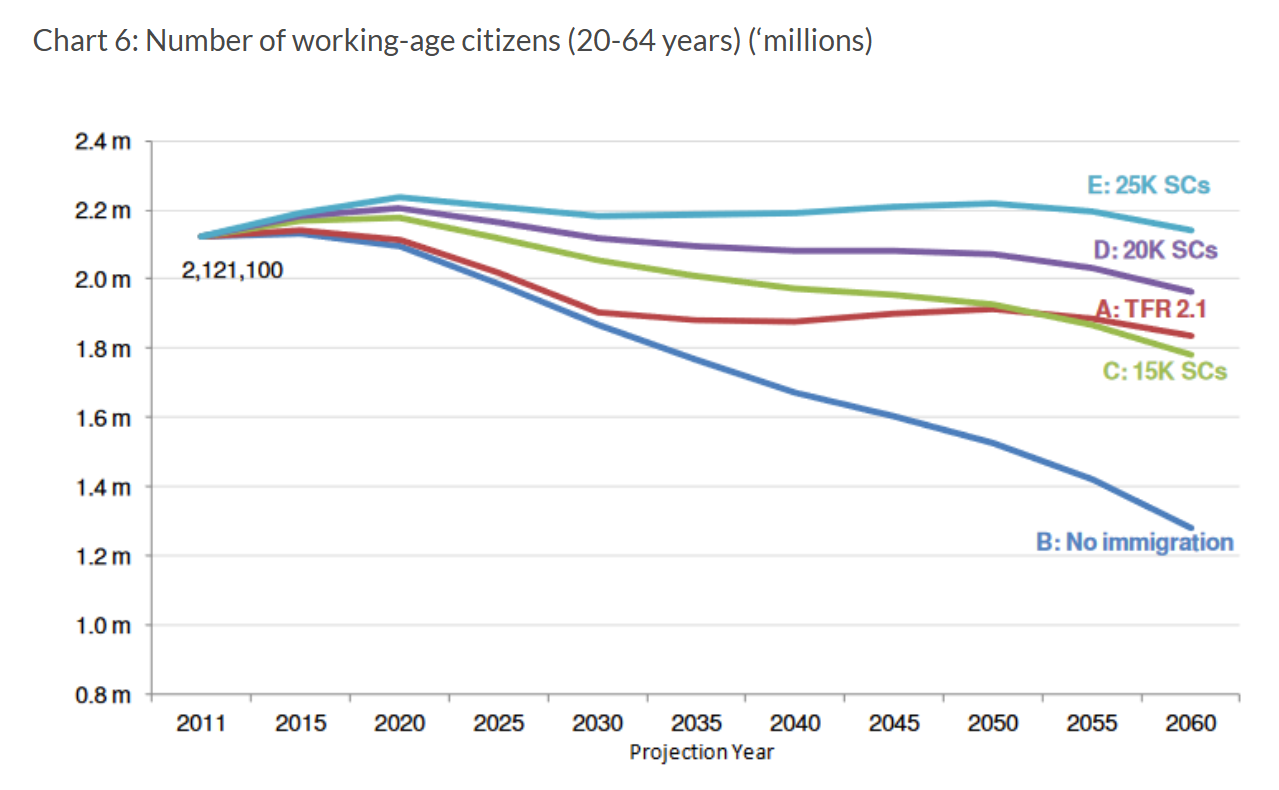
As you can see, immigration beats out even natural replacement through birth, because the country accepts more working (and breeding) age adults, who are able to prop up its economy better than either pensioners or children can.
And, again, it's at the ca. 25,000 new citizens per year, where Singapore achieves stability at levels comparable to today, although this number is under pressure now and is being revised upwards given the still declining TFR.
Summing up, Singapore has decided to balance its citizen population by naturalising 25,000 to 30,000 foreigners to:
1. Achieve long-term stability of the citizen population.
2. Support national defence with sufficient number of conscripts.
3. Maintain ethnic proportions within the CMI system.
4. Prevent rapid ageing of the society, which puts undue pressure on working age citizens having to support a growing share of pensioners.
Inward naturalisation of this scale is not meant to grow the local population, but merely keep it stable over the coming few decades.
And each year the country grants citizenships to tens of thousands of foreigners, it does so for residents who have already proved themselves living and working in the country over the previous few years.
Given the projections showing Singapore citizen figures flatlining at around 4 million and PM Wong's latest commitment that Singaporeans will remain a majority in their own country, it's clear that the city is approaching its long-term population limits.
At the current ratio of 60% citizens to 40% non-citizens, Singapore would top out around 6.6 million people. The upper bound is defined by the 50/50 split, which would put it at around 8 million.
As a result, the realistic middle option seems to be around 7 million, from the current total of 6.1 million. This is the margin that the country is going to work within in the next few decades.
The age of rapid population growth in Singapore appears to be over. It's now all about managing the quality over quantity of its immigrants – and its citizens.


