

During the National Day Rally speech, Prime Minister Lawrence Wong unequivocally stated that Singaporeans will never become a minority in their own country.
This echoes his earlier comments, made before he even assumed premiership, where he compared Singapore to the UAE, where local Emirati citizens currently make up only 10% of the total population.
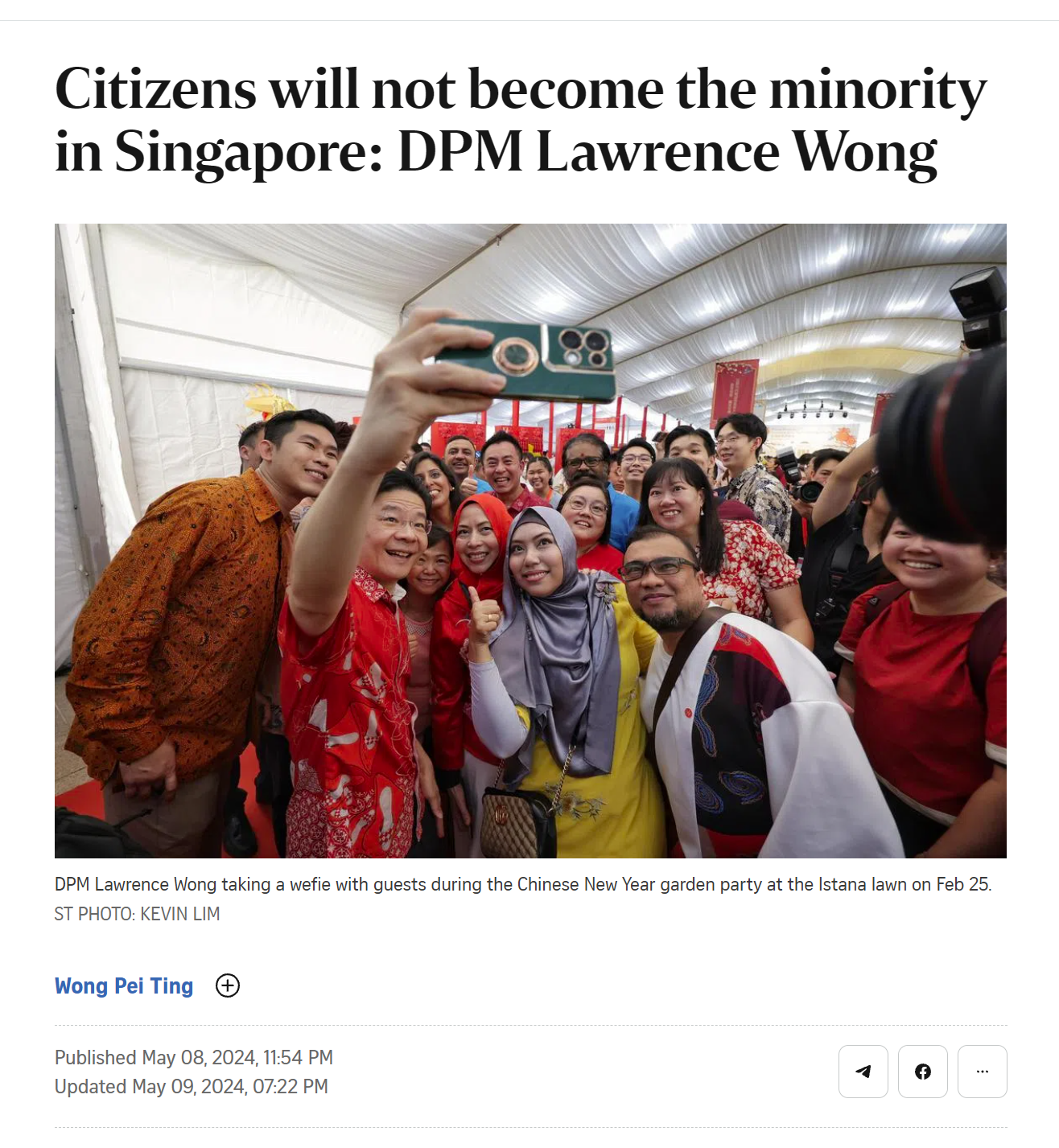
Here's what he told The Economist at the time:
“We cannot afford to be like the UAE, where the local residents are only less than 10% of the population.”
“They have a different compact because they use the oil and gas revenues to provide everything for the citizens. In return, they just allow foreigners to come in freely. That is not possible in Singapore.”
- DPM Lawrence Wong, 2024
However, there's a problem – this goal of ensuring Singaporeans remain the majority can only be accomplished through naturalisation of thousands of foreigners (quote from yesterday's speech):
"If we relied only on births, our citizen population will shrink. We would age more rapidly. And there would be fewer younger Singaporeans to support a growing number of seniors.
Over time, this would have profound consequences – for our economy, our society, and our ability to keep Singapore going. And that is why for many years, we have supplemented our population by welcoming new citizens."
- PM Lawrence Wong, NDR 2026
In other words: immigrants are necessary for Singapore and the only practical difference between the city-state and the UAE is how they are labelled.
Emiratis decided to keep citizenship highly exclusive, while Singapore is opting to extend it to up to 30,000 people per year, to keep the local core population growing this way, given the extremely low fertility rates.
You know me as one of the biggest fans of the PAP, but even I have to concede that, in this context, the promise that "Singaporeans will remain a majority" sounds at least a bit misleading.
Furthermore, the argument that the UAE can allow foreigners to freely flow into the country, because it's so rich in oil and gas that it can provide plenty of benefits for local citizens, seems illogical too.
Shouldn't that mean that it could actually afford having MORE citizens than Singapore?
Since citizenship comes with many entitlements, isn't it much cheaper to provide them for a smaller group, instead of growing it by naturalising thousands of foreigners each year?
Unlike an expat, every new Singaporean is entitled to subsidised HDB apartments, education, healthcare and periodic cash or coupon handouts from the state – not to mention being able to vote in elections.
Foreigners in Singapore pay higher taxes, receive fewer (if any) public benefits, usually have to cough up free market rates for their private residence and higher stamp duties if they do make a property purchase.
So, they cost less and contribute more.
The only thing that the country gains with a citizen is a potential future NSman – but only assuming that the naturalised families have a son (although, remember, the same obligation already applies to PRs too).
The Emirati Model
In contrast, it is famously difficult to obtain Emirati citizenship. This, of course, is a consequence of local culture and the country's history. Unlike Singapore, it was not built by immigrants, but local Arab tribes.
Just like a foreigner cannot be Chinese or Japanese, it would be really strange to see non-Arabs with Emirati passports (it does happen, but is very rare). In many countries citizenships are tightly tied to ethnicity.
But is that a bad thing? And isn't there a lesson for Singapore?
For millions of foreigners living in the UAE, the country is their home. But because they are not citizens, they have no claim against the state.
Complete control remains in Emirati hands.
And it is an absolute monarchy to begin with, where citizens have fairly limited means of influencing domestic politics (so, newcomers would have minimal impact).
Meanwhile, democracies – like Singapore – give every new citizen the right to vote on the country's future.
This sounds like a much better reason to be selective about who is admitted, and how many of them.
UAE has a bit over 1 million citizens and around 11 million immigrants working and living locally, contributing to the local economy and federal/emirate budgets, which then disburse exclusive benefits to just 10% of the inhabitants.
Would Singapore be worse off if, in the future, its citizen population gradually decreased to an elite core of 2-3 million people, with the remainder being a migrant majority that pays a premium to live and work in the city-state?
Within the same population size, a much larger portion would contribute to fund benefits for the privileged, local minority. Is that really an undesirable model?
The balancing act
On paper, then, Emirati approach seems to have no weak points. Citizenship is treated as an exclusive membership, which comes with generous benefits, inaccessible to foreigners.
Meanwhile, the country remains attractive to immigrants, who are willing to accept the extra costs to live there, even though they never qualify for the full support package reserved for the locals.
Given that Singapore is a democracy, it appears to be an even better fit for such a policy, which would keep power in the hands of a smaller, tighter group of long-time Singaporeans (who would also be cheaper to provide for in terms of housing, healthcare or education).
So, why has PAP opted to grow the local population through naturalisation? Two words: ethnic balancing.
Back in 2013 min. Grace Fu admitted in Parliament that Singapore's immigration policy is deliberately calibrated to preserve the core ethnic balance of the citizen population – which is roughly 75% Chinese, 15% Malay and 7.5% Indian.
Lawrence Wong has just repeated that commitment during his NDR speech:
"Every community will continue to have its place in Singapore – its language, culture and traditions. And that is why we will continue to broadly maintain our current ethnic balance. This has served Singapore well and it continues to give every community confidence – that their place, representation and voice in Singapore remain secure."
- PM Lawrence Wong, NDR 2026
Because the Malay minority continues to register much higher fertility rates, a regular intake of ethnic Chinese and Indians is required to maintain that balance. Otherwise, the Malay share would gradually creep up towards 20% or more, potentially raising tensions with the other two groups.
At the same time, Singapore's domestic Chinese population has already started shrinking rapidly. Last year, the number of deaths among Chinese Singaporeans exceeded births by 3,000 people. Conversely, Malay and Indian populations grew by 3,000 and 1,200 respectively.
To keep the ethnic composition the same, Chinese population would have to grow by a net 15,000 (with a further 300 Indians needed to keep their share).
Given the 3,000 person deficit, it means that 18,000 foreigners of Chinese descent have to be naturalised each year to plug that gap (which is likely to keep growing). Together with Indians, that is responsible for over 73% of the roughly 25,000 citizenships that Singapore issues annually.
In other words, nearly 3/4 of the yearly intake of new citizens can be explained just by the need to maintain ethnic proportions of the Singaporean society.
That is before we take into account the overall ageing or simply rewarding well-integrated residents who apply to make Singapore their home, regardless of their origin.
Paradoxically, this need for CMI balancing stems from the fact that Singapore is a democracy – which, as I observed at first, made it a great candidate to copy the Emirati immigration model.
But because Singapore is ethnically diverse, and because it has long struggled to maintain social cohesion, any impression of its constituent groups that they are getting outnumbered by the other could have social and political ramifications.
For that reason, the government chose to simply keep the ratios as they have always been, to avoid rocking the boat.
Today, facing the fertility imbalance between them, it has to import a certain number of people each year only to make good on that commitment, performing an incredibly delicate balancing act, between ethnic sensitivies, economic needs of an ageing society, and local discontent about the rising number of immigrants.
Emirati model objectively makes a lot of sense – but only under the condition that the citizen population is highly homogeneous. Once you add diversity to the mix, the solutions that first seemed obvious become far less so.


