

Singapore has completed its official political salary framework update, the first one in 15 years, with significant raises for everybody, from the lowly MPs all the way to Prime Minister.
Here's the breakdown published by the Straits Times:
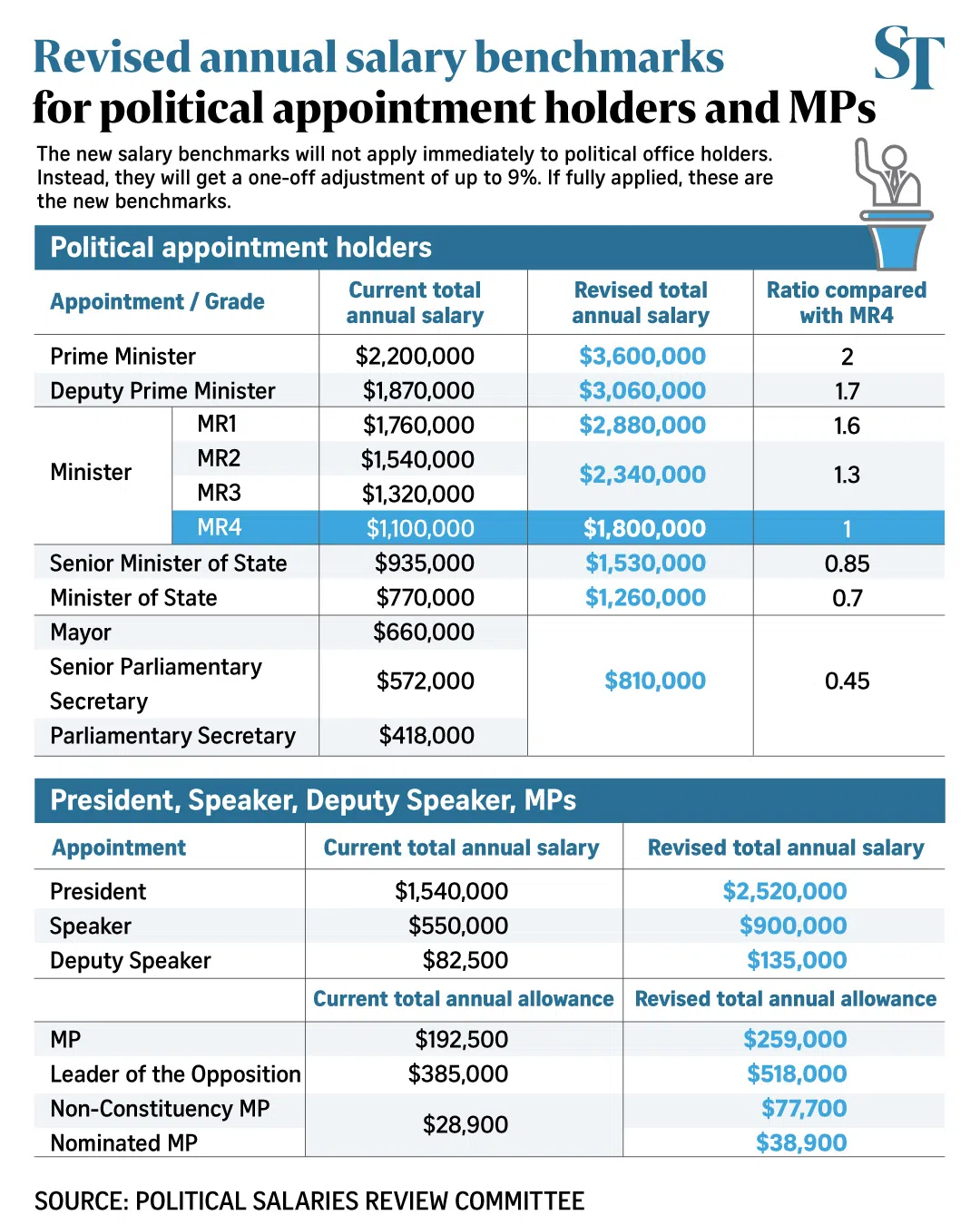
The PM and cabinet ministers are seeing a boost of 64% – which, for PM, translates into S$1.4 million a year. However, while it sounds massive on paper, not only is it going to be delayed but already falls behind the average incomes in the economy.
In 2011, when the old levels were set, the median salary in Singapore was S$3,249. In 2025 it was S$5,775 – more than 77% higher.
And since we don't have the latest figures for 2026, the cumulative increase is likely to exceed 80%.
Which means that PM Wong has only received a long-overdue increment, which isn't even matching the performance of the country, while the current ministers won't actually see the money for years and will only get a 9% bump in October.
Even MPs have the right to feel short-changed, given that their salaries have only gotten a 34.5% increase.
As if that wasn't enought, they missed out on years of real market progression, that regular workers get, and have set themselves up for another 15 years of falling behind yet again.
Some people will say that millionaire ministers don't need any more money – but that's not the point. The point was to create a solution that would make politics an attractive career for the best people.
For a place like Singapore, where the government is not only running the country but controls significant business stakes through designated companies, which are providing close to S$30 billion annually in Net Investment Returns Contributions, the value created by the entire administration is immense – and far greater than by any individual corporation, even the biggest foreign MNCs.
The whole idea of paying the world's highest salaries, was to make political offices attractive to top performers, so that they consider a career in the government instead of chasing lucrative private sector jobs, where they would both earn more money and not have to worry about public exposure to know-it-all haters.
What's more, not only does the ministerial pay receive a 40% "social service" cut from the median of the best paid 1,000 Singaporeans (that their incomes are measured against) but it is frozen for many years, creating an even bigger gap over time.
Which brings me to my point about PM Wong donating his raise to charity for the next 5 years: it's a politically understandable gesture which, however, shouldn't be necessary in a mature society.
The political leadership has clearly thought it was a little too controversial to tell Singaporeans that their PM is getting a S$1.4 million raise, while they complain about 20 cents on their cup of kopi, so now he officially promised to donate it to charity for the next 5 years.
But what happens next?
The can was just kicked down the road. After five years of donations is he going to say "now it's all mine!"? If he stops giving it's going to look bad, if he continues, it's going to slowly hollow out the system.
However controversial the high ministerial salaries may seem, Singapore has decided on them for a reason.
It should stick to its path and reaffirm its superiority over what the rest of the world is practicing, where office holders are paid relatively less on paper, but then use their powers in not always legal ways to amass far more wealth by questionable means.
Nearly every other country has a problem with incompetent, corrupt crooks in charge, who then end up costing the society far more than a good salary would, while the smartest elite works in the private sector.
Singaporean politicians shouldn't feel pressure to make any generous gestures, because they aren't doing anything bad. Quite the contrary. Considering the results, their employment is a bargain.
Featured image: MDDI Photo by Kendrick Wong


