

I have always found it interesting how Jamus Lim is able to maintain an attractive image of a sensible opposition politician, while peddling ideas that would put him among left-wing extremists even in the West (like the wealth tax of up to 2% – the highest rate anywhere in the world).
Now, the good professor of economics, is trying redesign shopping mall food courts to save Singaporean cuisine.
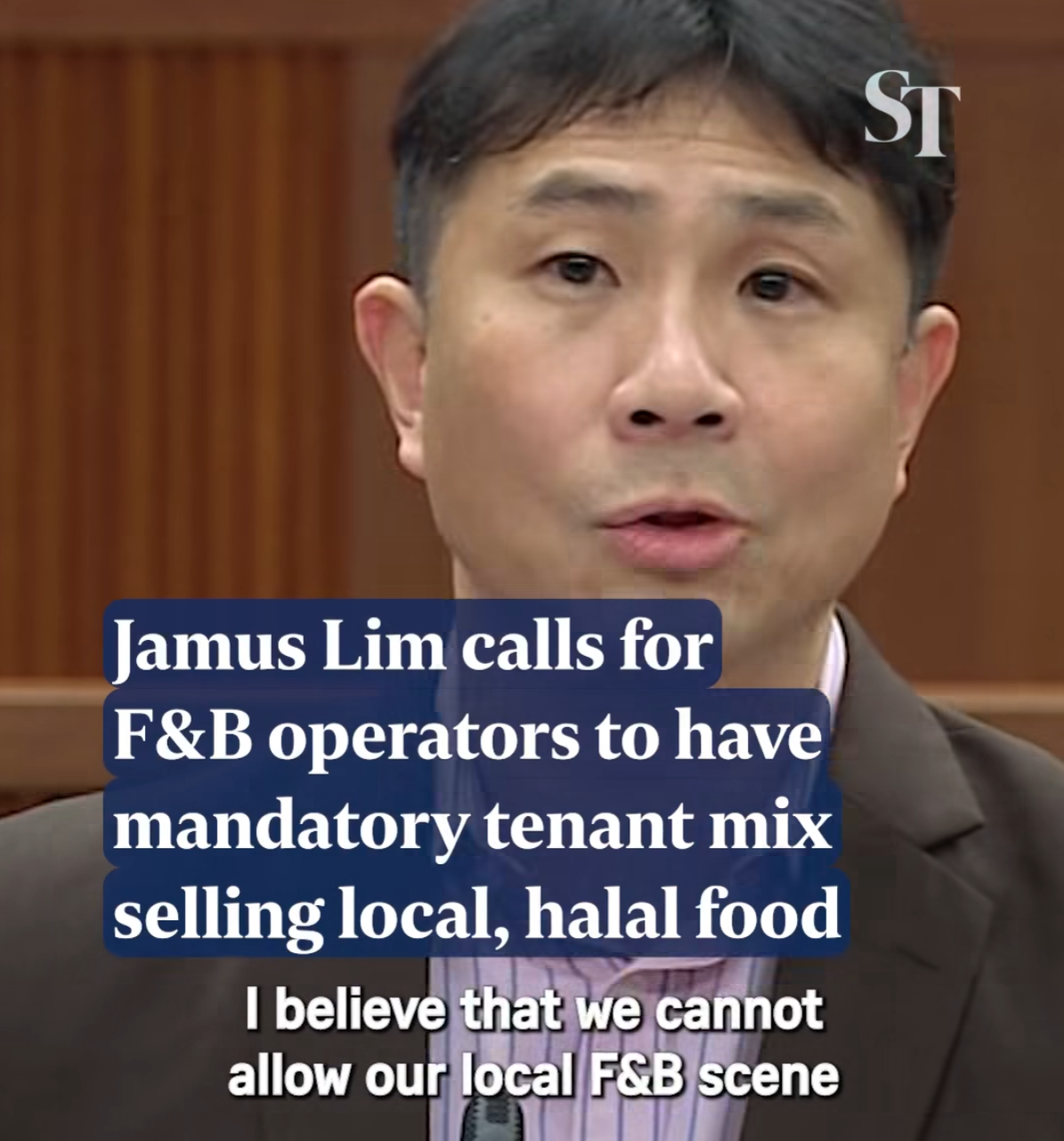
Apparently, subsidised hawker centres are not enough, and the government should now dictate the food mix in shopping malls and coffee shops – and Jamus Lim has it all designed in his head.
Not only is he saying that there should be a mandatory minimum quota for local food outlets and halal options, but that non-complying premise owners should face penalties if they don't meet them.
Mind you, this is no longer about impoverished hawkers, struggling to survive, but successful local chains like Ya Kun or Old Chang Kee. Workers' Party appears to believe that it's a Singaporean entitlement to have a familiar food brand in every mall. Government-sponsored hawker centres are no longer enough.
It's pretty funny seeing someone who is actually teaching economics, and yet doesn't believe in the fundamental laws of supply and demand – or their consequences.
First of all, Jamus Lim appears to assume that local companies are dying to get a spot in every mall, but are increasingly outbid by foreign competitors (usually from China) who have deep pockets and can accept much higher rents, even if they lose money, just to establish regional presence.
Even if we assume that is true in some cases, who exactly is going to be the judge of that?
The business model and products of e.g. Luckin Coffee and Ya Kun, while related, are fundamentally different.
Should the government evaluate how much of the growth in rental rates is due to supposedly predatory practices of Chinese chains and which of them are accepting a loss, only to get the foot in the door? And what if it turns out they actually make a profit? Wouldn't that vindicate their decision to invest and simply reveal that local companies can't profitably compete in free market conditions in a particular location?
And if that's the case, isn't that profitability a vote of confidence given by willing consumers themselves?
So, what is Jamus Lim proposing? That a successful business, which Singaporeans like to patronise, should be replaced by a less popular one only because it's local?
Is he going to guarantee that said local chain is going to make money? And if it doesn't, who's going to cover the losses? The Workers' Party? :)
Nobody, not even foreign companies, can operate at a loss forever. Either they turn it into a profit or they are going to bail out, opening up opportunities to those local companies that Jamus believes were neglected.
Another allegation is that if that happened, they would leave behind inflated rents, which the property owners are not eager to lower because it reduces the paper valuation of their commercial portfolio (in short: the market value of a commercial building is a multiple of its predicted rental revenue stream – so a small cut in rental translates into a big drop in value) a phenomenon not unique to Singapore.
But he also ignores the fact that they are able to offer other arrangements to potential tenants, which preserve the rental rates on paper, while effectively cutting them in practice (e.g. by offering rent-free periods).
Again – the laws of supply and demand usually find a way.
And why should halal outlets get special treatment? The share of Muslim population in the society is just 15%. With foreign workers it may be a fair bit more – but they do not have quite the same purchasing power.
Aren't private restaurant operators already aware of where in Singapore halal food should be served? Don't they know who their customers are? Why should some bureaucrat decide this for them?
This is completely absurd.
The government's role ends at preserving access to cheap food, served at hawker centres. This is because it's the basis around which much of life in Singapore revolves. It is important not only for cultural reasons but for the functioning of the country, as millions of people depend on it daily.
If hawkers were priced out of the market, it would force more people to cook at home, costing precious time and likely leading to loss of national culinary heritage.
But this idea that government intervention should suddenly extend to shopping malls or private kopitiams is crazy.
The government exists to guarantee a basic minimum – in terms of food, healthcare, housing, transit or education. But everything above that is left to the free market. That's the Singapore way – which is also why the country functions as well as it does.


